

International

Questions & Answers - 2026 World Cup
The World Team Table Tennis Championships begin in London on Tuesday. The tournament, which has been extended to 13 days, is intended to serve as the highlight of the centennial celebration of the first World Championships, which were also held in the British capital 100 years ago.
Who are the favorites?
In theory, China in both competitions. In theory, because only China’s women’s team still possesses its customary dominance. The Chinese men, on the other hand, have been a mystery for quite some time; in recent months, they have unexpectedly often been defeated by opponents from other countries. It therefore remains to be seen whether the “Great Wall of China” has merely developed isolated cracks in the course of a generational shift or whether it has actually been shaken to its very foundations.
Is this an opportunity for other nations?
To a certain extent—especially in the team competition, opponents would need not just a perfect moment for a single victory, but a perfect day to secure the three individual points necessary for success. The most likely contenders are European champion France, Olympic silver medalist Sweden, as well as Japan and South Korea. The German team, for years China’s undisputed number one challenger, is likely to be nothing more than a spectator in the title race.
What are the German teams’ overall chances?
It varies. After the DTTB failed to win a single team medal in Busan two years ago—the first time since 2016—the German women’s European champions, in particular, are confidently setting a medal as their goal. For the men, the situation is more difficult despite having a top-10 player and two other top-20 players: In the race for the four podium spots (both semifinalists receive bronze), the DTTB team would have to outperform its world ranking to win a medal.
Why are the DTTB teams not entering the tournament until the fifth day of the World Championships?
Because the World Championships have been expanded—in other sports, B World Championships are held for lower-ranked teams prior to the group stage in London. Even the first three matches of the DTTB teams against three of the other top teams to determine the final seeding in the World Championship bracket are hardly worth more than a “golden pineapple,” because the tournament practically doesn’t begin until after that with the knockout stage.
What is the format?
Of the 64 participants, the eight highest-ranked teams according to the world rankings will compete in two groups of four to determine the top seeds. For the knockout stage featuring 32 teams, the group winners and the six best second-place finishers from 14 additional groups—comprising teams ranked ninth and lower—will also qualify. The remaining four spots in the bracket are filled by the winners of four playoff matches featuring the eight remaining second-place finishers. In particular, the early matches between top-ranked teams—played solely to determine seeding and well before the event’s crunch time—have drawn widespread criticism.
Who should we keep an eye on?
Definitely Sabine Winter—and not just from a German perspective. With her breathtaking rise to the World Cup podium and into the top 10 of the world rankings, the 33-year-old has sparked a sensation in the table tennis world. The secret to Winter’s success is the anti-spin rubber on her backhand, which absorbs any spin on the ball from her opponent’s shots. Even the Chinese players now have to fear Germany’s number one.
Will the World Championships be broadcast on TV?
Yes—but not all of them. The pay-TV channel Dyn will begin its live streams from London on May 2, coinciding with the German teams’ entry into the World Championships. In addition, the Cologne-based channel will broadcast selected matches featuring top teams and from the later knockout stages.
Source: SID
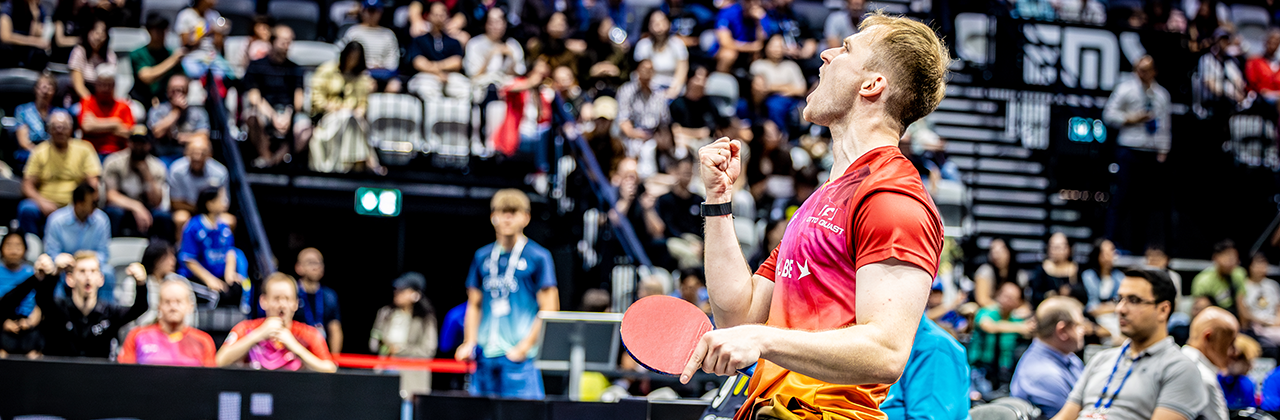
Featured image above: Patrick Franziska (Photo: BeLaSportfoto)